Dream Research
What sleep does to memory, and why cramming does not survive the night
Learning does not end when you stop studying. A substantial part of it happens while you are unconscious, in a process that can be observed, disrupted, and — with a well-timed sound — steered.
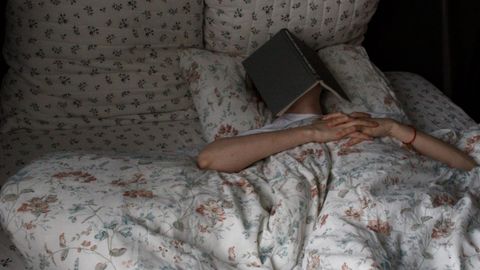
The most-cited experiment in this field is more than a century old. In 1924, John Jenkins and Karl Dallenbach had participants learn nonsense syllables, then either sleep or stay awake for the same interval before being tested. The sleepers remembered substantially more.
Their interpretation was passive: sleep protects memory by preventing new experience from interfering with it. Nothing is happening; nothing is being disturbed.
That explanation lasted until researchers could watch what the sleeping brain was actually doing, at which point it became clear the process is anything but passive.
Replay
In 1994, Matthew Wilson and Bruce McNaughton recorded from place cells in the rat hippocampus — neurons that fire when the animal is in a particular location. As a rat ran a track, a specific sequence of cells fired in order.
During subsequent slow-wave sleep, the same sequences fired again, in the same order, at roughly twenty times the original speed. The brain was rerunning the route.
This has been replicated extensively, in rodents and, using intracranial recordings, in humans. Replay is more frequent after novel or rewarded experiences, and the amount of replay predicts subsequent performance.
The active systems consolidation model
The dominant framework holds that the hippocampus is a fast, temporary store, and the neocortex is a slow, permanent one. Sleep is when material moves between them.
The mechanism involves three oscillations locking together during slow-wave sleep: cortical slow oscillations at under 1 Hz, thalamic sleep spindles, and hippocampal sharp-wave ripples. The ripples, carrying replayed sequences, nest inside spindles, which nest inside the up-states of the slow oscillation.
That nesting appears to be the transfer window. Experiments that disrupt the coupling impair consolidation; experiments that enhance it — including transcranial stimulation applied in phase with the slow oscillation — improve memory in some studies.
Learn a set of object locations while a particular sound or odour is present. Play that same cue quietly during subsequent slow-wave sleep, below the threshold that would wake the sleeper. Memory for the cued items improves relative to uncued ones.
This has been replicated many times since Björn Rasch's 2007 rose-odour experiment. It does not implant memories or teach anything new — it biases which existing memories get replayed. Which is remarkable enough.
Different sleep for different memory
The picture is not uniform.
Declarative memory — facts, events, locations — is most associated with slow-wave sleep and with spindle density. People with more spindles consolidate more, and spindle density correlates with general cognitive ability.
Procedural memory — motor skills, sequences — is more associated with stage 2 and REM. Learn a finger-tapping sequence, sleep, and you perform measurably faster the next day without further practice. The gain does not occur across an equivalent period of wakefulness.
Emotional memory is preferentially consolidated, and REM appears central to it. This selectivity has an obvious logic — the emotionally significant is worth keeping — and an obvious downside in conditions where distressing memories are consolidated too well.
Forgetting is part of it
A memory system that kept everything would be useless. Two proposals address the other side.
Giulio Tononi and Chiara Cirelli's synaptic homeostasis hypothesis argues that waking experience potentiates synapses across the brain, which is unsustainable — energetically expensive and saturating. Slow-wave sleep downscales synaptic strength globally, preserving relative differences while restoring capacity. What survives is what was strongest.
Sleep also appears to support abstraction. In a well-known experiment by Ullrich Wagner and colleagues, participants worked on a number problem containing a hidden shortcut. Those who slept between sessions were more than twice as likely to discover it. Sleep did not supply the answer; it appears to have extracted the underlying structure from the examples.
What this means for learning something
Sleep after learning matters more than sleep before it, though both help. The consolidation window is the night following acquisition.
An all-nighter before an exam is close to the worst available strategy. It sacrifices consolidation of everything studied that day, degrades retrieval, and impairs the reasoning needed to use the material.
Spacing beats massing, and part of why is that spaced study inserts more nights of sleep between sessions.
Naps work. A nap containing slow-wave sleep produces measurable consolidation benefits. Sixty to ninety minutes captures more than twenty, at the cost of grogginess on waking from deep sleep.
Alcohol before bed is a poor idea for a learner, since it suppresses REM in the first half of the night and fragments the second.
The caveat
Effect sizes in this literature vary considerably, some findings have replicated less well than the enthusiasm suggests, and much of the human work uses artificial laboratory tasks whose relationship to learning a subject over a term is not established.
What is not in doubt is the direction: sleeping after you learn something is better than not, and the mechanism is active rather than merely protective.
Also by Tomás Bélanger
- Why do we dream? Four serious theories and what each one gets rightDream Research
- Lucid dreaming: what is actually established and what is wishful thinkingLucid Dreaming
- Falling, teeth, being chased: why the same dreams recur across the worldSymbols & Meaning
- Why some people remember every dream and others remember noneDream Research