Sleep Science
What actually happens across a night of sleep
Sleep is not a single state you fall into and climb out of. It is four distinct conditions the brain cycles through, and the order they arrive in explains almost everything about how a night feels.
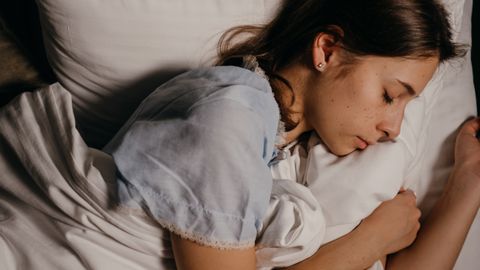
Before the 1950s, sleep was widely assumed to be a passive state — the brain switching off until morning. Then Eugene Aserinsky, a graduate student in Nathaniel Kleitman's laboratory in Chicago, noticed that the eyes of sleeping infants moved in bursts, and that the accompanying brain activity looked nothing like unconsciousness. It looked like wakefulness.
That observation opened up the field. Sleep turned out to be several different states, cycling in a predictable architecture, and the brain is in some of them working harder than it does while awake.
The four states
Modern scoring divides sleep into three non-REM stages and REM.
N1 is the transition — the couple of minutes between wakefulness and sleep. Alpha waves give way to slower theta activity. This is where hypnic jerks happen, the sudden whole-body twitch that jolts you awake, and where hypnagogic imagery appears: the drifting fragments most people never remember. Woken from N1, people frequently deny they were asleep at all.
N2 is the bulk of a night, roughly half of total sleep time. It is defined by two signatures on the EEG: sleep spindles, brief bursts of 11–16 Hz activity generated by the thalamus, and K-complexes, large sharp waves that often follow an external sound. Both are thought to be involved in keeping you asleep — gating sensory information at the thalamus so the noise outside does not reach the cortex — and spindles are strongly implicated in memory consolidation.
N3 is slow-wave sleep, sometimes called deep sleep. The EEG shows high-amplitude delta waves under 4 Hz, with large populations of cortical neurons firing in near-synchrony. This is the hardest stage to be woken from, and the stage from which you wake up confused and thick-headed if you are. Growth hormone is released here. So is most of what is thought to be the brain's overnight clearance activity.
REM is the strange one. The EEG resembles waking. Brain metabolism is high. The eyes move rapidly under closed lids. And the body is paralysed — motor neurons are actively inhibited at the brainstem, leaving only the diaphragm and the eye muscles working. Most vivid narrative dreaming happens here.
Sleep runs in cycles of roughly 90 minutes, four to six times a night. But the composition shifts as the night goes on: slow-wave sleep dominates the first third, and REM dominates the last third. This is why cutting a night short at either end removes different things — going to bed two hours late costs you deep sleep, waking two hours early costs you REM.
Why the architecture matters
That asymmetry has consequences people notice without understanding.
If you sleep six hours instead of eight by getting up early, you have lost around a quarter of your total sleep and perhaps half of your REM. If you sleep six hours by going to bed late, you have lost a disproportionate share of slow-wave sleep. The two produce different mornings.
Alcohol illustrates the same principle from another angle. It shortens the time to fall asleep and suppresses REM in the first half of the night, then produces a rebound in the second half — fragmented sleep, vivid dreams, and waking at four in the morning. The total hours may look fine. The architecture is wrecked.
The muscle paralysis, and what happens when it fails
REM atonia is not incidental. Without it, you would physically act out the motor commands your brain is generating.
Michel Jouvet demonstrated this in the 1960s with lesion experiments in cats: damaging the brainstem region responsible for atonia produced animals that, during REM, got up and performed behaviours — stalking, pouncing, grooming — while still asleep.
The human equivalent is REM sleep behaviour disorder, in which the paralysis is incomplete and people physically enact their dreams, sometimes violently. It is worth knowing about, because it is strongly associated with later development of Parkinson's disease and related conditions.
The reverse failure is sleep paralysis: waking while the atonia is still in force. You are conscious, you cannot move, and because the REM-generating machinery is still running, hallucinations frequently bleed into the room. It is harmless and terrifying, and it has produced a substantial share of the world's folklore about night visitors.
What determines when you sleep
Two systems, working independently, and understanding both explains most sleep problems.
Homeostatic pressure builds the longer you are awake. Adenosine, a by-product of cellular energy use, accumulates in the brain across the day and is cleared during sleep. It is the substance caffeine blocks — caffeine does not supply energy, it prevents you noticing how tired you already are, which is why the crash arrives when it wears off.
Circadian rhythm is an independent roughly-24-hour cycle generated by the suprachiasmatic nucleus, entrained mainly by light. It sets when you feel sleepy regardless of how long you have been awake.
When the two align, sleep is easy. When they conflict — as in jet lag, shift work, or a very late night followed by an early alarm — you can be exhausted and unable to sleep at the same time.
How much of this can you feel?
Less than you would think. People are poor at estimating their own sleep: insomniacs typically underestimate how long they slept, and people with sleep apnoea are frequently unaware of hundreds of arousals a night.
Which is the honest caveat to everything above. The architecture is real, it is measurable, and your subjective sense of a night's sleep is only loosely connected to what actually happened in it.
Also by Nadia Eriksen
- Your body clock is a physical structure, not a metaphorSleep Science
- Nightmares are treatable, and the treatment involves rewriting the endingNightmares & Disorders
- Are you really a night owl? What chronotype is and how much of it is fixedSleep Science
- Insomnia: the treatment that works is not a tabletSleep Science