Nightmares & Disorders
Nightmares are treatable, and the treatment involves rewriting the ending
Chronic nightmare disorder affects several per cent of adults, wrecks sleep, and is rarely asked about. The best-supported treatment takes about four sessions and involves changing the story while awake.
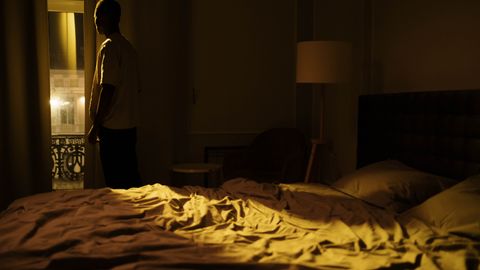
Occasional nightmares are universal. Nightmare disorder is different: repeated distressing dreams that wake the sleeper, cause significant distress or impairment, and persist. Prevalence estimates for frequent nightmares in adults run at roughly two to six per cent, considerably higher in people with post-traumatic stress disorder, where rates above 70 per cent are commonly reported.
The consequences are not confined to the night. Chronic nightmares produce sleep avoidance — people stay up to delay the risk — which produces sleep deprivation, which increases REM pressure, which increases nightmares. They are independently associated with depression, anxiety and, in several studies, with suicidality, and that association survives adjustment for depression severity.
They are also, in most clinical settings, not asked about.
Nightmares versus night terrors
The two are frequently confused and are entirely different phenomena.
Nightmares occur in REM sleep, mostly in the second half of the night. The sleeper wakes fully, is oriented, and remembers a coherent narrative in detail.
Sleep terrors are a non-REM parasomnia, arising from deep slow-wave sleep in the first third of the night. The person may scream, sit up, appear terrified, and be extremely difficult to rouse. They are not really awake, they are usually inconsolable, and — the key diagnostic feature — they typically have no memory of it at all in the morning. It is the observer who is traumatised.
Sleep terrors are common in children and usually outgrown. In adults they warrant assessment, particularly for sleep apnoea, which fragments deep sleep and can trigger them.
Select a recurring nightmare — not the most traumatic one, to begin with. Write it down. Then change it, in any way you choose, anywhere in the narrative. The change does not have to be logical or brave; it only has to be different. Rehearse the new version while awake, in vivid imagery, for 10–20 minutes a day.
That is essentially the whole protocol. Typically four to six sessions. It has the strongest evidence base of any nightmare treatment and is recommended as first-line by the American Academy of Sleep Medicine.
Why rewriting works
Nobody is certain, and there are two plausible accounts.
The first is that chronic nightmares are a learned pattern — a rehearsed script the brain replays — and rehearsing an alternative competes with it. Barry Krakow, who developed the approach, framed nightmares as a habit rather than a symptom, which is part of why the treatment does not require processing the original trauma.
The second is that the therapeutic ingredient is the shift in agency. A nightmare is defined by helplessness. Deliberately authoring the dream, even while awake, changes the dreamer's relationship to it, and the reduction in anticipatory anxiety about sleep reduces the arousal that fragments it.
Notably, the treatment does not require the rewritten dream to appear. Many people improve without ever dreaming the new version.
What else has support
Exposure, relaxation and rescripting therapy combines imagery rehearsal with sleep hygiene and relaxation training and has good trial evidence in PTSD-related nightmares.
Lucid dreaming therapy — training the person to recognise the nightmare as a dream — has been tested in small controlled trials with promising results.
Prazosin, an alpha-1 adrenergic blocker, reduces nightmares in PTSD in several trials, though a large multi-site trial in veterans was negative, which cooled enthusiasm considerably. It remains an option where psychological treatment is unavailable or insufficient.
Treating the sleep apnoea. An under-recognised contributor: apnoea causes arousals from REM, and in some patients nightmares resolve with CPAP.
The things that make nightmares worse
REM rebound. Anything that suppresses REM and is then withdrawn produces a compensatory surge — alcohol, some antidepressants, cannabis. Withdrawal nightmares after stopping heavy cannabis use are a well-documented and under-warned-about phenomenon.
Alcohol before bed, for the same reason within a single night.
Medications. Beta blockers, some antidepressants, dopamine agonists, varenicline and several others list vivid dreams or nightmares as recognised effects.
Sleep deprivation, which increases REM pressure.
Fever and illness.
Trauma, obviously — though it is worth noting that post-traumatic nightmares often do not replay the event literally. They frequently reproduce the emotion in a different scenario.
What to do tonight, and what to do about it properly
Keeping a nightmare log for two weeks is genuinely useful — it establishes frequency, identifies patterns, and gives a clinician something concrete to work with.
Reduce alcohol in the evening. Keep the sleep schedule regular, since irregular sleep increases REM instability. And if you have been avoiding bed to avoid the dreams, that avoidance is now part of the problem and is worth naming.
Then ask for imagery rehearsal therapy by name. It is brief, it is well evidenced, and it is not offered nearly as often as it should be — largely because most people never mention nightmares to a doctor at all.