Nightmares & Disorders
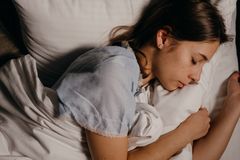
Sleep paralysis: awake, aware, unable to move, and often not alone
The mechanism is simple and well understood. The experience is one of the most frightening things a healthy person can undergo, and it has generated remarkably consistent folklore across the world.
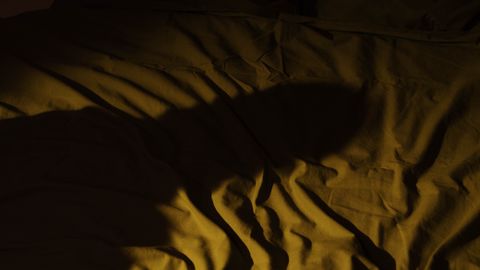
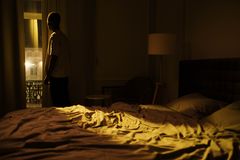
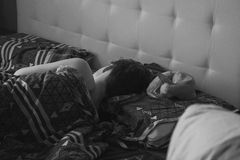
You wake. You are aware of the room. You cannot move — not a finger, not your head. Your breathing feels constricted. There is a weight on your chest. And, with some frequency, there is something in the room with you.
It lasts seconds to a couple of minutes, ends abruptly, and leaves the person shaken in a way that is difficult to convey afterwards.
What is happening
During REM sleep the brainstem actively inhibits motor neurons, producing atonia — the paralysis that stops you acting out dreams. Sleep paralysis is a dissociation between two processes that normally end together: consciousness returns while the atonia persists.
The result is a genuinely hybrid state. You are awake enough to perceive the room accurately. You are still in REM enough that the paralysis holds and the dream-generating machinery continues to run — which is where the hallucinations come from.
It is common. Lifetime prevalence estimates cluster around 8 per cent of the general population, considerably higher in students and in psychiatric populations, and higher still in people with narcolepsy, where it is one of the classic tetrad of symptoms.
The three kinds of hallucination
Researchers have described a fairly consistent structure, and knowing it helps enormously with the fear.
Intruder. A sense of a malevolent presence, sometimes with a visual figure — a shadowy shape, a hooded form, a figure at the door. This is often the most frightening element and appears to arise from threat-detection systems activating in a state where the person cannot check or flee.
Incubus. Pressure on the chest, difficulty breathing, sometimes a sense of being held down or choked. The respiratory component has a plausible explanation: during REM, breathing is shallow, rapid and largely diaphragmatic, and the intercostal muscles are atonic. Attempting to breathe voluntarily against that produces exactly the sensation of restriction.
Vestibular-motor. Sensations of floating, flying, falling, spinning, or of leaving the body. This cluster is the likely origin of a substantial proportion of out-of-body and abduction experiences, and it tends to be less frightening than the other two.
Sleep deprivation · irregular sleep schedules · shift work and jet lag · sleeping supine, which is associated with a markedly higher rate · stress and anxiety · alcohol · some medications · and narcolepsy, where it is a core symptom rather than an isolated event.
The folklore, which is unusually consistent
Because the experience is so specific and so widespread, cultures have independently produced remarkably similar explanations.
The English word nightmare comes from the mare, a malevolent being that sits on the sleeper's chest — cognate with the German Mahr and the Old Norse mara. Henry Fuseli's 1781 painting The Nightmare, with an incubus crouched on a sleeping woman, is a near-literal depiction.
In Newfoundland it is the Old Hag, and to be attacked is to be "hagged". In Japan it is kanashibari, being bound in metal. In Turkey, the karabasan. In Egypt, a jinn. In parts of the Caribbean and West Africa, being ridden by a witch. In Thailand, phi am. In Korea, gawi nulim, being pressed by scissors.
The convergence on a crushing weight, a nocturnal presence, and immobility across cultures with no contact is one of the better arguments that a shared physiology is generating a shared narrative — and a good demonstration of how a neurological event becomes a supernatural one when no other explanation is available.
Devon Hinton's work on khmaoch sângkât among Cambodian refugees found that cultural interpretation substantially affects distress: those who believed the episodes indicated spiritual attack experienced far greater fear and greater subsequent anxiety.
What to do about it
For isolated episodes, the single most effective intervention is knowing what it is. Recognising the experience as a recognised, harmless, self-limiting state — rather than as an assault or the onset of madness — substantially reduces the terror and, because fear prolongs the episode, often shortens it.
Practical measures:
- Do not fight it. Struggling to move increases panic and appears to extend the episode. Focusing on slow, calm breathing helps.
- Try small movements. Fingers, toes, eye movements — the extremities and eyes are often the first to become available and can break the state.
- Sleep on your side. The supine association is strong enough to be worth acting on.
- Regularise sleep and get enough of it. Deprivation and irregularity are the main triggers.
- Reduce evening alcohol.
When to see someone
Frequent episodes, particularly with excessive daytime sleepiness, cataplexy — sudden muscle weakness triggered by emotion — or hypnagogic hallucinations, warrant assessment for narcolepsy, which is treatable and frequently diagnosed years late.
Otherwise, sleep paralysis is unpleasant, harmless, and considerably less frightening once it has a name.
Also by Nadia Eriksen
- What actually happens across a night of sleepSleep Science
- Your body clock is a physical structure, not a metaphorSleep Science
- Nightmares are treatable, and the treatment involves rewriting the endingNightmares & Disorders
- Are you really a night owl? What chronotype is and how much of it is fixedSleep Science