Nightmares & Disorders
Sleep apnoea: hundreds of times a night, and most people have no idea
The airway collapses, oxygen falls, the brain briefly wakes to reopen it, and the whole sequence repeats until morning. The sleeper usually remembers none of it and wonders why they are so tired.
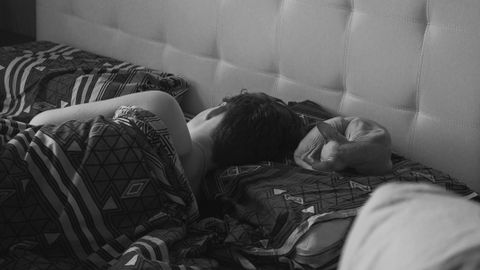
During sleep the muscles of the upper airway relax. In most people the airway stays open. In obstructive sleep apnoea it narrows or collapses, airflow stops or is substantially reduced, blood oxygen falls, carbon dioxide rises, and after some seconds the brain produces a brief arousal — usually too short to be remembered — that restores muscle tone and reopens the airway, often with a gasp or a snort.
Then it happens again. In severe cases, more than thirty times an hour, every hour, all night.
What it does
Two mechanisms cause the damage.
Sleep fragmentation. Hundreds of arousals prevent progression into deep and REM sleep. The person is in bed eight hours and obtaining very little restorative sleep, which produces the characteristic daytime sleepiness.
Intermittent hypoxia. Repeated cycles of oxygen desaturation and reoxygenation generate oxidative stress, inflammation and sympathetic activation. Blood pressure surges with each event. Over years this contributes to hypertension — sleep apnoea is a leading identifiable cause of resistant hypertension — atrial fibrillation, stroke, insulin resistance and heart failure.
Who has it, and who is missed
Prevalence estimates vary with the threshold used, but studies applying modern criteria to general populations find moderate-to-severe apnoea in a substantial minority of middle-aged adults, and the majority of cases are undiagnosed.
The classic picture — middle-aged, overweight, male, loud snoring — is accurate but incomplete, and it causes systematic misses.
Women are under-diagnosed. Prevalence rises sharply after menopause, presentations are more often insomnia, fatigue, morning headache and mood disturbance rather than dramatic snoring, and referral rates are lower.
Thin people get it. Craniofacial anatomy — a small or set-back jaw, a narrow airway, large tonsils — matters independently of weight, and is a particularly common cause in East Asian populations.
Children get it, usually from enlarged tonsils and adenoids, and it presents as hyperactivity, inattention and behavioural problems rather than sleepiness. It is misdiagnosed as ADHD with some regularity.
Witnessed pauses in breathing · loud snoring with gasping or choking · waking unrefreshed despite adequate hours · morning headache · dry mouth on waking · nocturia more than twice a night · falling asleep unintentionally when inactive · resistant hypertension · atrial fibrillation. Witnessed apnoeas are the most specific — ask whoever sleeps near you.
Diagnosis
Home sleep apnoea tests use a portable device recording airflow, respiratory effort, oxygen saturation and heart rate over one or more nights. They are adequate for uncomplicated moderate-to-severe disease and have transformed access.
Full in-laboratory polysomnography adds EEG, and is needed where the picture is unclear, where central apnoea is suspected, where there is significant cardiac or neuromuscular disease, or where another parasomnia is in question.
The apnoea–hypopnoea index counts events per hour of sleep: 5–15 mild, 15–30 moderate, over 30 severe. It is a crude summary — the degree of desaturation, the extent of fragmentation and the symptom burden all matter, and two people with the same index can be affected very differently.
Treatment
CPAP delivers pressurised air that splints the airway open. It abolishes events reliably and improves sleepiness, quality of life and blood pressure. Its effect on hard cardiovascular endpoints has been less clear than expected — the SAVE trial found no significant reduction in events, with average adherence around three hours a night, which is likely too little.
Adherence is the central issue. Mask fit is the largest single factor and trying several types is normal. Humidification helps dryness. Pressure ramping helps tolerance. Auto-titrating devices adjust through the night. Most people who abandon CPAP do so in the first fortnight, which is exactly when support matters most.
Mandibular advancement devices hold the lower jaw forward. Less effective than CPAP at abolishing events but often better tolerated, and a reasonable option in mild to moderate disease. They require adequate teeth and a dentist experienced in fitting them.
Positional therapy for people whose events occur predominantly on their back — a meaningful subgroup.
Weight loss reduces severity substantially where there is excess weight, and the newer GLP-1 agonists have shown notable effects in trials specifically targeting apnoea.
Surgery — tonsillectomy in children is curative in most cases. In adults, upper airway surgery has variable results; hypoglossal nerve stimulation, an implanted device that activates the tongue muscles in time with breathing, is effective in selected patients.
Avoiding alcohol and sedatives in the evening, both of which relax the airway and worsen events.
Central sleep apnoea
A different condition with the same name pattern. Here the airway is open but respiratory effort stops — a failure of respiratory control rather than obstruction. It occurs in heart failure, where Cheyne–Stokes breathing is characteristic, in people on long-term opioids, and at altitude.
It needs specialist management. Adaptive servo-ventilation, once used for it, increased mortality in patients with heart failure and reduced ejection fraction in the SERVE-HF trial, which was an important and unwelcome finding.
Why it is worth pursuing
People with treated apnoea frequently describe the change in terms that sound exaggerated — that they had forgotten what being awake felt like. Given that many have been sleeping badly for a decade without knowing, the description is probably accurate.
Also by Nadia Eriksen
- What actually happens across a night of sleepSleep Science
- Your body clock is a physical structure, not a metaphorSleep Science
- Nightmares are treatable, and the treatment involves rewriting the endingNightmares & Disorders
- Are you really a night owl? What chronotype is and how much of it is fixedSleep Science