Lucid Dreaming
False awakenings: the dream where you get up and start your day
You wake, get out of bed, make coffee, and then wake again. Some people go through the loop several times in a night, and the experience is unsettling in a way ordinary dreams are not.
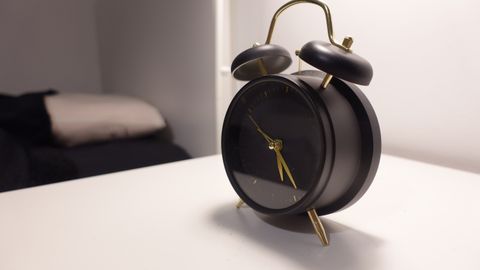
A false awakening is a dream of waking up. The dreamer experiences getting out of bed and beginning the ordinary business of the morning, in a setting that is usually a faithful reproduction of their own bedroom, and then genuinely wakes — sometimes to repeat the whole thing.
Celia Green, who studied them in the 1960s, distinguished two types that remain useful.
Type 1 is the mundane version. The dreamer simply gets up and proceeds with an ordinary morning until something goes wrong or they wake. These are common and generally unremarkable except in retrospect.
Type 2 is stranger and considerably less pleasant. The dreamer wakes into a bedroom that is subtly wrong, with an atmosphere of tension or dread, a sense of anticipation, and sometimes a presence. Green described a distinctive stressed, apprehensive quality. Type 2 false awakenings shade into sleep paralysis and share some of its phenomenology.
Why they happen
No settled explanation, but several observations constrain it.
False awakenings are strongly associated with lucid dreaming — many occur immediately after a lucid dream ends, and a lucid dreamer who believes they have woken may simply have entered another dream. They are also associated with fragmented sleep, with anticipation of an important morning, and with sleeping in an unfamiliar place.
One plausible account is that they represent a partial arousal in which the brain begins running its waking-morning script — a well-rehearsed routine requiring little novel construction — while remaining asleep. The bedroom is the most over-learned environment a person has, which is why it is reproduced so convincingly.
Another is that they are a variety of dream in which the content happens to be waking, and they seem special only because the subject matter is unusually consequential to the dreamer's sense of what is real.
Text and digital displays are notoriously unstable in dreams. Read something, look away, and read it again — in a dream the text typically changes. Digital clocks are especially unreliable. Light switches frequently do not work properly. And in a false awakening, the bedroom is often subtly wrong: a door where none should be, furniture in the wrong place, the wrong view from the window.
The loop
Nested false awakenings — waking from a false awakening into another one, several times — are widely reported and are the version that disturbs people most.
They are a favourite of film for obvious reasons, and the fictional treatments have arguably made the experience more frightening than it was, by attaching an implication that one might never get out. In practice the loop always ends, usually within a few cycles, and the dreamer wakes properly.
The connection to lucidity
This is where false awakenings become useful rather than merely odd.
A false awakening is a dream in which the dreamer has an unusually strong sense of being awake — which makes it a prime opportunity for a reality check to catch something. Lucid dreaming practitioners are taught to perform a reality test every time they wake up, precisely because a proportion of those awakenings are not real.
Get in the habit, and false awakenings convert from disorienting to productive: the check fails, you realise you are dreaming, and you have a lucid dream you did not have to work for.
The reverse relationship also holds. People who take up lucid dreaming often report an increase in false awakenings, probably because the practice raises the general level of self-monitoring during sleep.
When they are distressing
For most people these are a curiosity. For a minority they are unpleasant, particularly the type 2 variety, and particularly when they cluster.
Two things help. Understanding that the experience is recognised, common and harmless does a surprising amount of work, as with sleep paralysis. And addressing the sleep fragmentation underneath — irregular timing, alcohol, sleep deprivation, an untreated sleep disorder — reduces frequency, since false awakenings cluster around disturbed sleep.
Where they occur alongside frequent sleep paralysis, excessive daytime sleepiness or hypnagogic hallucinations, the combination is worth mentioning to a doctor, since it can point toward narcolepsy.
The philosophical footnote
False awakenings are the everyday version of a very old problem. Zhuangzi dreamed he was a butterfly and, on waking, could not establish whether he was a man who had dreamed he was a butterfly or a butterfly now dreaming he was a man. Descartes used the difficulty of distinguishing dreaming from waking as a step toward radical doubt.
The practical answer, unsatisfying to philosophers and adequate for everyone else, is that waking life has properties dreams reliably lack: stable text, working light switches, continuous memory, and coherent physics. The check works. It is just that in the moment, you have to remember to do it.
Also by Tomás Bélanger
- Why do we dream? Four serious theories and what each one gets rightDream Research
- What sleep does to memory, and why cramming does not survive the nightDream Research
- Lucid dreaming: what is actually established and what is wishful thinkingLucid Dreaming
- Falling, teeth, being chased: why the same dreams recur across the worldSymbols & Meaning