Symbols & Meaning
Dreams of the dead: the most common dream nobody prepares you for
Most bereaved people dream of the person they lost. The dreams follow a pattern, most find them comforting, and a significant minority find them unbearable — and both responses are normal.
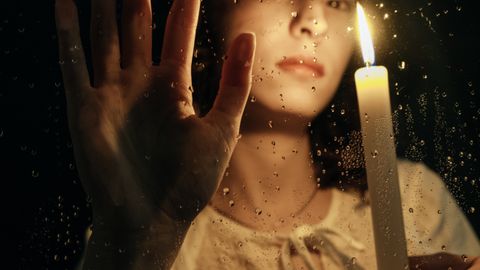
Surveys of bereaved people consistently find that a majority — commonly 50 to 80 per cent depending on the population and how long after the death — report dreaming of the person who died.
These dreams are frequently described in terms quite different from ordinary dreaming. People report them as unusually vivid, as feeling more real than dreams normally do, and as carrying a strong sense of presence. Researchers sometimes call them visitation dreams, using the term descriptively rather than making any claim about what they are.
The pattern over time
Joshua Black's work, and earlier research by Patricia Garfield and others, describes a rough trajectory.
Early dreams often reproduce the illness, the death, or the circumstances around it. The person appears sick, dying, or in distress. These are the most difficult and are more common where the death was traumatic, sudden, or witnessed.
Middle-period dreams tend to show the person restored — healthy, younger, well. Frequently there is a message, explicit or implied, that they are all right. Communication may be verbal or may be a simple conveyed knowledge.
Later dreams often place the person in ordinary scenes without the death being at issue. They are simply present.
This is a tendency rather than a rule. Many people report dreams that do not follow it, and dreams of the same person can continue for decades.
The dream where they are alive. The dreamer experiences the death as having been a mistake or a misunderstanding, and then wakes — and loses them again. This is widely reported as the most painful kind, because it repeats the bereavement.
The dream where they are angry, or will not speak. Common where the relationship was difficult or where there is unresolved guilt, and often deeply distressing because it is read as a judgement.
How people receive them
The research finding that surprises people is that most bereaved dreamers describe these dreams as comforting rather than distressing, and many describe them as among the most significant experiences of the bereavement.
Reported effects include reduced grief intensity, a sense of continued connection, reassurance about the person's wellbeing, and — where the dream involves communication — a sense of resolution about something unsaid.
A substantial minority, though, find them painful, and there is no reliable way to predict which group someone will fall into. People whose grief is complicated, whose relationship with the deceased was conflicted, or whose loss was traumatic are more likely to have distressing versions.
The theoretical framing
The dominant model in bereavement research since the 1990s is continuing bonds, developed by Dennis Klass, Phyllis Silverman and Steven Nickman. It replaced an older model in which healthy grief meant detaching from the deceased and reinvesting elsewhere.
The continuing bonds view holds that maintaining a transformed relationship with the dead is normal, adaptive and near-universal across cultures — through memory, ritual, internal conversation, objects, and dreams. Dreams of the dead are, on this account, one of the ordinary mechanisms of that continued relationship rather than a failure to let go.
Rosalind Cartwright's work on divorce provides an adjacent finding with the same shape: those whose dreams featured the former spouse, and whose dream narratives evolved over time, adapted better than those whose did not.
Culturally
Interpretations vary enormously and this affects how the experience lands.
In many traditions a dream of the dead is understood as genuine contact — the deceased visiting, bringing a message, or requiring something. Ancestor-focused traditions across Africa, East Asia and elsewhere treat such dreams as communication requiring response, sometimes ritual response. In parts of Latin America and the Caribbean, dreams of the dead around particular festivals carry specific meaning.
In secular Western contexts the same dream is more often understood as internally generated and as a psychological event, which changes the response from ritual to reflection.
Neither framework makes the dream less common. What differs is what the dreamer does afterwards, and whether they have anyone to tell.
What is worth saying to someone
Three things, from the literature and from what bereaved people report wanting.
That these dreams are very common — many people assume they are unusual and do not mention them for fear of sounding unwell.
That there is no correct interpretation required. Whether the dream is understood as contact or as the mind's own work is a question the dreamer can leave open, and does not need to settle in order to take comfort from it.
That distressing versions are also normal, and that a dream in which the dead person is angry is not evidence of anything except that the relationship was complicated — which was probably already known.
Where such dreams are frequent, distressing, and preventing sleep, the same treatment that works for nightmares applies: imagery rehearsal therapy, which is brief and well evidenced. That is a rare case where a dream of the dead is something to treat rather than something to sit with.
Also by Priya Raghunath
- Dream incubation: the ancient practice of sleeping somewhere on purposeMyth & Folklore
- Jung, archetypes and the collective unconscious: a sceptical readingSymbols & Meaning
- The mare, the hag and the jinn: how one physiological event became a global folkloreMyth & Folklore
- Aboriginal Australian Dreaming is not about dreamsMyth & Folklore