Nightmares & Disorders
Sleep talking, teeth grinding and the other noises of the night
Somniloquy is harmless and reveals nothing. Bruxism can destroy your teeth and is frequently a sign of something else. The two get grouped together and should not be.
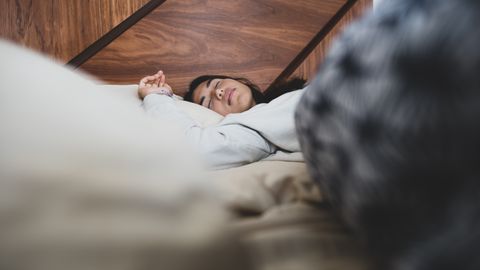
Two of the more common things people do audibly in their sleep, with quite different implications.
Sleep talking
Somniloquy is extremely common — most people do it at some point, and a substantial minority do it regularly. It occurs in all sleep stages, both REM and non-REM, and is classified as a parasomnia only when frequent enough to disturb others.
Content is generally unremarkable. Studies analysing recorded sleep speech find it is mostly brief, frequently mumbled or unintelligible, and often fragmentary. A study by Isabelle Arnulf's group in Paris recorded a large number of sleep talkers and found something interesting: the speech followed normal grammatical structure, included pauses appropriate for turn-taking as though in conversation, and contained a high proportion of negation and profanity — considerably more than in waking speech.
They interpreted this as evidence that sleep speech engages ordinary language production machinery, and that the content skews toward conflict, consistent with the general negative bias of dream content.
It is not a truth serum. Sleep speech is fragmentary, frequently unrelated to anything real, and generated by a brain with impaired reality monitoring and no access to intention. Confessions, names and accusations produced during sleep have no evidential value whatsoever, and treating them as meaningful has caused a great deal of unnecessary domestic distress.
Sleep talking on its own requires no treatment. It warrants attention only when it accompanies something else — sleepwalking, dream enactment, or apparent distress — or when it begins suddenly in an adult, which occasionally accompanies stress, fever, medication changes or another sleep disorder.
Bruxism
Sleep bruxism — involuntary grinding or clenching of the teeth during sleep — is a different matter, because it causes damage.
Prevalence estimates in adults run around 8 to 12 per cent, higher in children, declining with age. It is classified as a sleep-related movement disorder rather than a dental problem, which is a relatively recent reclassification and an important one.
Consequences: tooth wear, sometimes severe; cracked teeth and failed restorations; jaw muscle pain and hypertrophy; temporomandibular joint symptoms; morning headache, characteristically temporal; and disturbed sleep for a bed partner, since the noise can be considerable.
Why it happens
The understanding has shifted. Bruxism was long attributed to dental occlusion — a bad bite — and treated by adjusting the teeth. That model has been largely abandoned; occlusal adjustment does not reliably help and the evidence for a causal role is weak.
Current understanding places the origin centrally. Bruxism episodes occur in association with micro-arousals — brief transitions to lighter sleep accompanied by increases in heart rate and muscle tone. The grinding is part of an arousal sequence rather than an independent event.
This reframes the question: rather than asking why the jaw is grinding, ask why the person is having frequent arousals.
Associations include:
- Obstructive sleep apnoea, which is a major and under-recognised contributor. Apnoea causes arousals, and bruxism episodes frequently follow apnoeic events. Treating the apnoea often reduces the bruxism.
- Stress and anxiety, consistently associated.
- Medication — SSRIs and SNRIs are well documented as causing or worsening bruxism, as are some antipsychotics and stimulants.
- Caffeine, alcohol, nicotine and recreational stimulants, particularly MDMA.
- Gastro-oesophageal reflux.
- Genetics — there is a familial pattern.
Management
Occlusal splints — a hard acrylic guard worn at night. These protect the teeth from wear, which is their main purpose and which they do well. They do not reliably stop the grinding, and soft splints may in some cases increase muscle activity. A properly fitted hard splint from a dentist is preferable to an over-the-counter boil-and-bite version.
Screen for sleep apnoea. The single most useful step in an adult with significant bruxism, particularly if there is snoring, unrefreshing sleep or daytime sleepiness.
Review medication. If bruxism began after starting an SSRI, that is worth raising — dose adjustment or a switch sometimes resolves it, and adding buspirone has some evidence.
Reduce evening stimulants — caffeine, alcohol, nicotine.
Stress management and CBT have modest evidence.
Botulinum toxin injection into the masseter reduces the force of contraction and is used in severe cases. It does not stop the central mechanism, and repeated use has implications for muscle bulk and, in some reports, bone.
Awake bruxism is separate
Daytime clenching — during concentration, driving, or stress — is a distinct behaviour with a different mechanism, and it is more amenable to awareness-based approaches. Many people with jaw pain have both, and only the night-time version gets a splint.
A simple check: several times a day, notice whether your teeth are touching. At rest they should not be; there should be a small freeway space with the lips together. People who discover they are clenching most of the day have found something they can actually change.
Also by Nadia Eriksen
- What actually happens across a night of sleepSleep Science
- Your body clock is a physical structure, not a metaphorSleep Science
- Nightmares are treatable, and the treatment involves rewriting the endingNightmares & Disorders
- Are you really a night owl? What chronotype is and how much of it is fixedSleep Science